Digital Marketing
SEO vs. Paid Advertising: Which Digital Marketing Strategy Is Right for Your Business?
Paid ads are fast and rented. SEO is slow and compounding. A clear framework for deciding where your next marketing dollar should go.
- By Innovix Solutions LLC
- 7 min read
Every business that markets online eventually faces the same question: should the next dollar go to search engine optimization or to paid advertising?
The honest answer is that it depends, but not in a vague way. It depends on a handful of specific factors you can assess today. This guide compares SEO vs paid advertising on the dimensions that matter to a business, then gives you a framework for deciding which to lead with.
The core difference: renting versus building
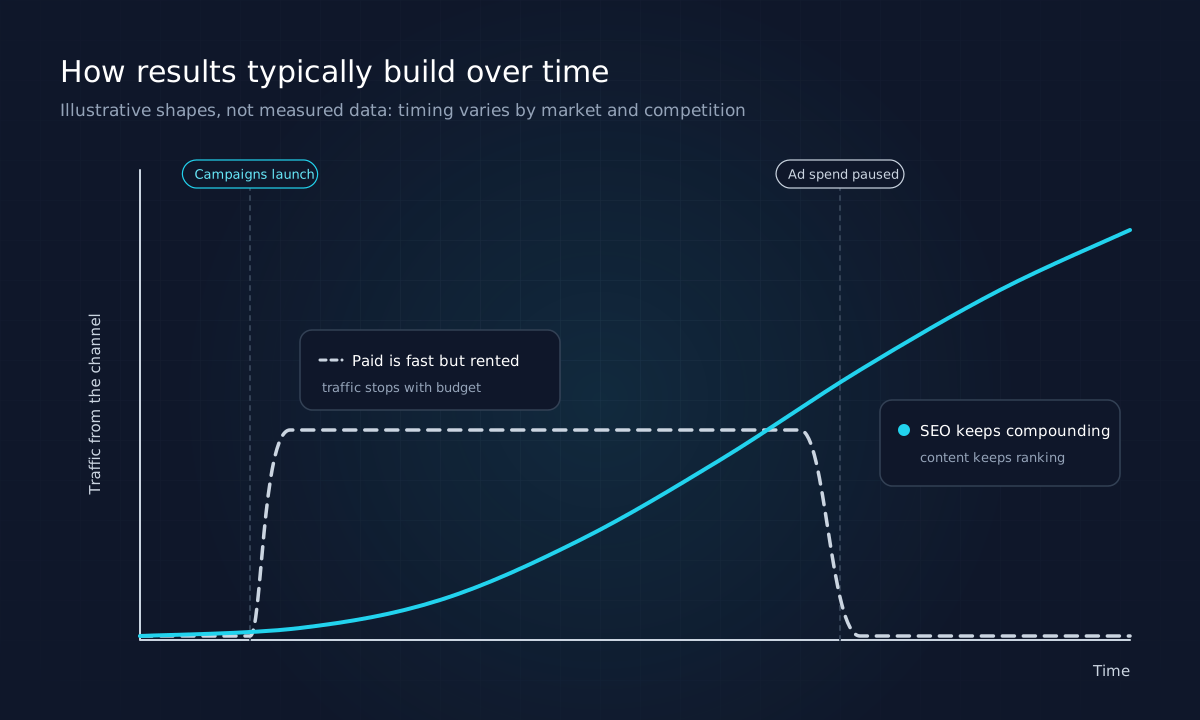
Paid advertising, such as Google Ads, puts your business at the top of search results or in front of an audience in exchange for payment, usually per click. Results can begin as soon as campaigns are live. When the budget stops, so does the traffic.
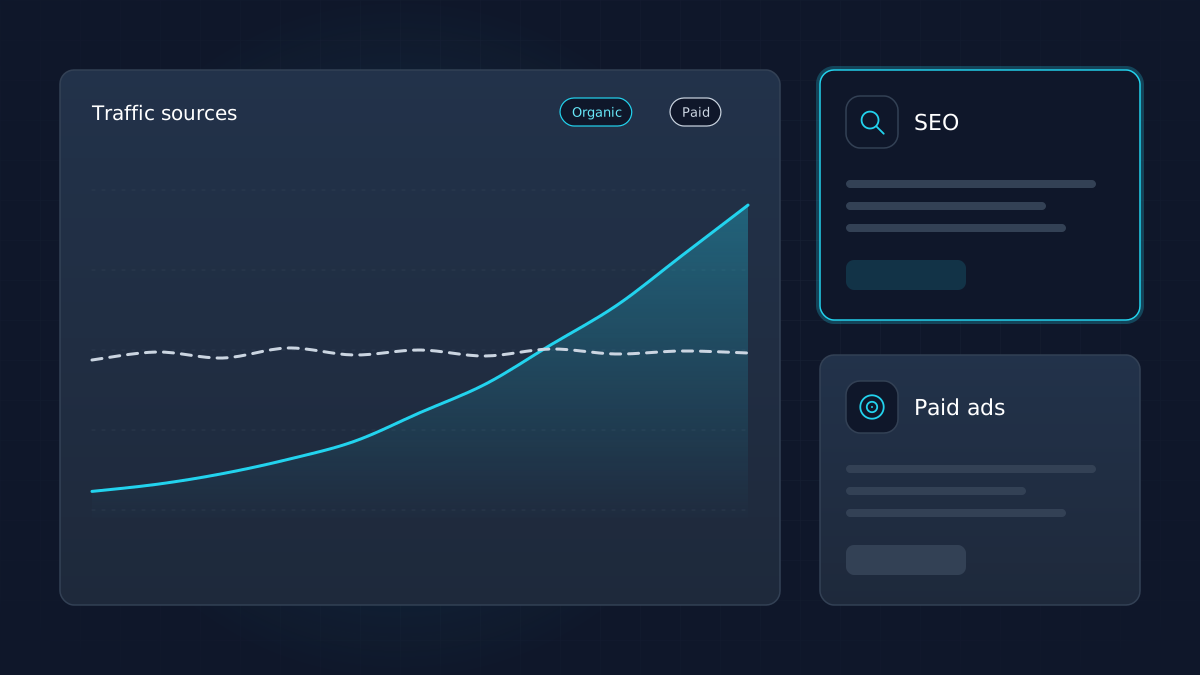
Search engine optimization improves your website's ability to appear in unpaid, organic search results. You invest in content, technical improvements and authority. Results take longer to appear, but visibility earned this way does not disappear the day you stop paying.
A useful way to think about it: paid advertising is renting attention, SEO is building an asset. Both have a place.
Side-by-side comparison
| Factor | SEO | Paid advertising |
|---|---|---|
| Speed to first results | Slow; often months | Fast; can be days |
| Cost structure | Ongoing investment in content and technical work | Pay per click or impression |
| What happens if you stop | Visibility tends to decline gradually | Traffic stops almost immediately |
| Control over targeting | Indirect: you choose topics, not who sees you | Direct: keywords, location, schedule, audience |
| Testing and learning | Slow feedback loops | Fast, measurable experiments |
| Credibility with searchers | Many users trust organic results | Clearly labeled as ads |
| Competitive pressure | Rankings take sustained effort to win and hold | Costs rise as more advertisers bid |
Neither column is universally better. The weighting depends on your business.
When paid advertising should lead
Google Ads marketing is often the right first move when:
- You need leads soon. A new business, a new location or a slow quarter cannot wait for organic rankings.
- You are testing an offer. Paid search shows quickly whether people search for and click on a new service, and which messages convert.
- Search intent is strong and specific. Searches such as "emergency plumber near me" or "commercial roof repair quote" signal immediate need. Appearing at the top for those terms can be very profitable.
- The organic results are dominated by large sites. Paid placement can secure visibility while you build authority.
The risks are cost and dependency. Without disciplined management, budgets leak into irrelevant searches. Use tight keyword targeting, negative keywords, dedicated landing pages and proper conversion tracking from day one.
When SEO should lead
SEO services tend to deliver the most value when:
- Your buyers research before they buy. Complex services, B2B purchases and high-value decisions involve many searches. Helpful content builds trust across that journey.
- Margins cannot support high click costs. In some industries, paying for every click is hard to justify. Organic visibility lowers acquisition cost over time.
- You have expertise to share. Detailed service pages, guides and answers to real questions are exactly what search engines aim to reward.
- You are building for the long term. Content that ranks can keep bringing visitors for years with periodic updates.
The risks are time and uncertainty. Search engines control rankings, algorithms change, and competitors also invest. Anyone who guarantees a specific ranking is overpromising.
Local businesses: the special case
If you serve customers in a defined area, local search deserves its own attention. Results for local queries often show a map with business listings above or alongside the regular results.
Local SEO focuses on an accurate, complete Google Business Profile, consistent business details across the web, location-relevant content on your site and genuine customer reviews. Local search ads can complement this for high-value terms. For many service businesses, the combination produces the most reliable business lead generation.
A decision framework you can use today
Answer these five questions:
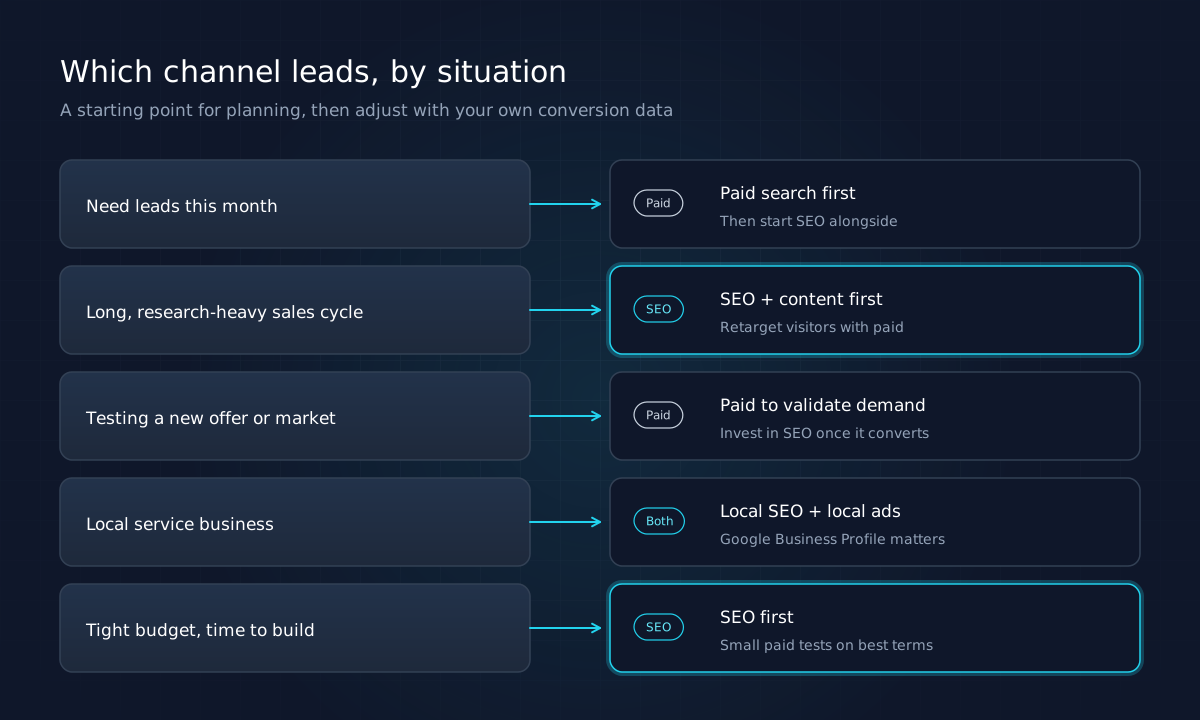
- How soon do you need new leads? Within a month points toward paid. Within a year allows SEO to contribute.
- What is a new customer worth? Higher customer value supports higher cost per click.
- How long is your sales cycle? Longer, research-heavy cycles favor content and SEO.
- How competitive are your keywords? Check who ranks and what they have invested.
- Can you measure results? Without conversion tracking, neither channel can be managed well.
Why most businesses should use both
The strongest digital marketing strategies treat SEO and paid search as complementary:
- Paid data informs SEO. Search terms reports show which queries actually convert, which helps prioritize content.
- SEO lowers blended cost. As organic visibility grows, paid budgets can shift to the terms where they perform best.
- Retargeting closes the loop. Visitors who arrive through organic content can be reached again with ads.
- Coverage across the page. Appearing in both paid and organic results for important terms reinforces credibility.
A common pattern is to lead with paid search for immediate demand, invest steadily in SEO and content, and rebalance the budget every quarter based on cost per qualified lead.
Common mistakes with each channel
Most disappointing results come from execution problems rather than the channel itself.
Paid advertising mistakes
- Sending all traffic to the homepage. Ads should land on a page that matches the search, with one clear action.
- Broad targeting without negative keywords. Budget leaks into searches from job seekers, researchers and people looking for something else entirely.
- No conversion tracking. Without it, campaigns are optimized for clicks rather than customers.
- Judging too early or too late. A few days of data is rarely enough to decide; months of unprofitable spend without changes is too long.
SEO mistakes
- Chasing high-volume keywords you cannot win. Specific, intent-rich topics often convert better and are more achievable.
- Thin service pages. One paragraph per service gives search engines little to rank.
- Publishing without a plan. Random blog posts rarely build authority. Organize content around the questions your buyers actually ask.
- Ignoring technical health. Slow pages, broken links and content hidden from crawlers undermine good writing.
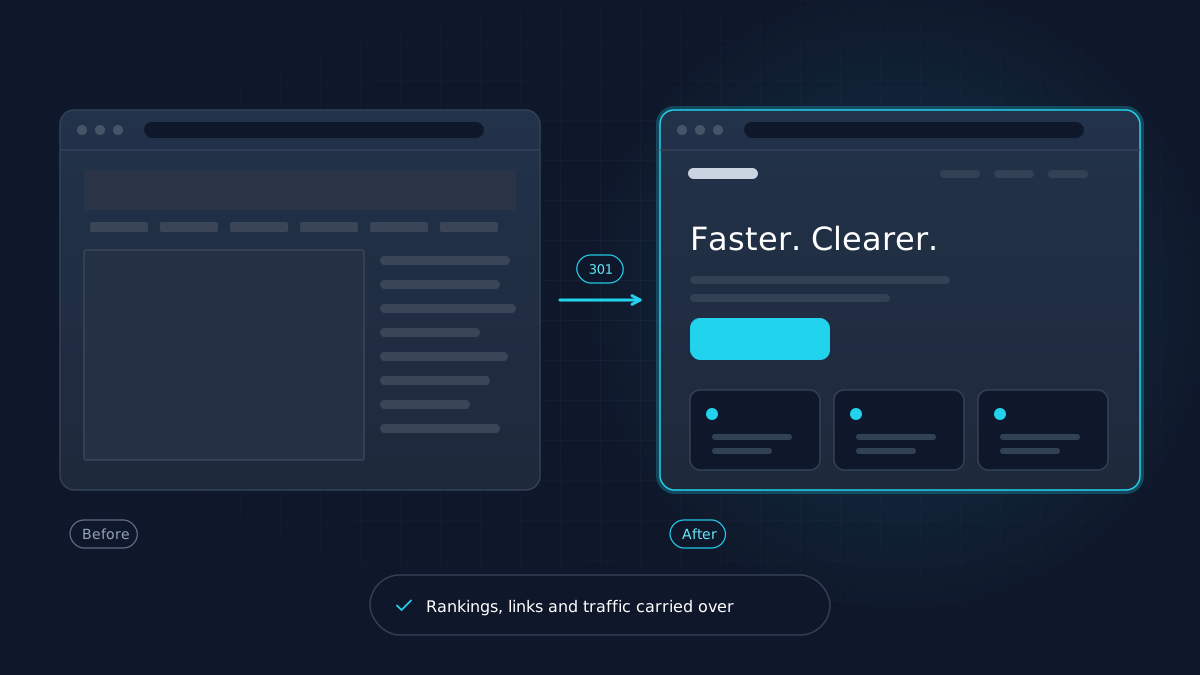
- Redesigning without redirects. A new site that changes URLs without 301 redirects can lose years of accumulated visibility.
What a balanced first year can look like
For a typical service business starting from a modest baseline, a balanced plan might unfold like this. Treat it as an illustration, not a prescription.
| Period | Paid search focus | SEO and content focus |
|---|---|---|
| Months 1–2 | Launch tightly targeted campaigns on high-intent terms; set up tracking | Technical audit; fix crawl and speed issues; improve core service pages |
| Months 3–5 | Cut wasted spend; test ad copy and landing pages | Publish in-depth content answering top buyer questions; build local presence |
| Months 6–9 | Shift budget toward best-performing terms | Expand content around topics that convert; earn links through useful resources |
| Months 10–12 | Rebalance based on cost per qualified lead | Update and consolidate content; review rankings and organic conversions |
The point is not the exact schedule but the rhythm: paid search provides early learning and leads, while SEO compounds in the background, and the budget follows the evidence.
Measure what matters
Clicks and impressions are easy to report and easy to misread. Track the metrics that connect to revenue:
- Conversions: form submissions, calls and purchases, tracked accurately
- Cost per lead and cost per customer, by channel
- Lead quality: how many leads become opportunities and sales
- Organic visibility trends for the topics that matter to your business, via Google Search Console
Make sure your website supports this. A slow or unclear site wastes both ad spend and organic traffic. Our checklist of essential website features covers the conversion foundations. If you are planning a new site, read our website redesign checklist first so you do not lose the rankings you already have.
The bottom line
Paid advertising buys speed and control. SEO builds durable visibility. Choose your lead channel based on urgency, customer value, sales cycle and competition, measure both by lead quality and cost, and expect the mix to change as your business grows.
Innovix Solutions provides digital marketing services including SEO, Google Ads management and analytics, along with website design and development to make sure the traffic you earn or buy actually converts. Online stores face extra considerations, covered in our guide to e-commerce website development.
Frequently asked questions
Neither is better in every situation. Paid advertising delivers visibility quickly and stops when spending stops. SEO takes longer to build but can produce traffic that continues without paying for each click. The right choice depends on your timeline, budget, competition and sales cycle.
Campaigns can start generating clicks as soon as they are approved and running. Producing qualified leads at an acceptable cost usually takes some weeks of testing keywords, ads and landing pages.
It varies widely. Technical fixes and improvements to existing pages can have an effect relatively soon, while ranking for competitive terms often takes many months of consistent work. Be wary of anyone who guarantees rankings or a fixed timeline.
Yes. Paid search data reveals which keywords convert, which can guide SEO priorities. Organic content builds credibility that can improve ad performance. Many businesses run both, shifting budget as organic visibility grows.
There is no universal figure. Work backward from goals: estimate how many leads you need, your typical conversion rate and the value of a customer, then set a budget that can produce those leads at a cost your margins support.